Movement/Fragment
Click here to see images and video of the project.
Click here to purchase prints.
The original text has been edited to protect myself and my family. Redactions have been replaced with [TEXT EDITED].
The last time I saw her in Canada -- the second to last time I saw her before her death --my father and I had to go and help her clear the social housing unit which had been her home over the last 10 years. I had fond memories of visiting that bright little room after a refreshing summer swim at the local aquatic centre. It was truly amazing how much STUFF one old woman could fit in a tiny studio flat: Piles and piles of paper clippings; boxes upon boxes of… boxes; those classic grandma blankets with oversized roses. We tried to salvage what we could --thinking that Value Village might still take some of this crap and maybe we could get some good karma by preventing textile waste.[1] However, the bedbugs hiding inside the seams of her coat, and the roaches crawling over each pile of clothes disincentivized us from doing anything but dumping her shit in the black bins behind our local strip mall. My grandmother had been in cognitive decline for many years. Though she was already forgetful, the social isolation of living in a foreign country during the COVID pandemic severely damaged her brain, as I’m sure it did to many of us. Though tears, fierce protests, and demands for a shipping container to ship ALL her good to Russia, we managed to reduce her luggage to a suitcase full of books and another of her favourite clothes. On her arrival, these were promptly sectioned off to the garage where I’m not sure what became of them.
Since Babushka’s return to Russia, my aunt, a public school teacher, had been looking after her. [TEXT EDITED] No one is a stranger to cognitive dissonance in my country, but I am sure that the weight of it all was hard to bear for one woman. It is no surprise that eventually, a visit was arranged to a nursing home, and Babushka was formally institutionalized -- gradually at first, then all at once. She would stay there for a month or two while my aunt overworked yet somehow still managed to find joy in teaching her students and through her own art. Finally, after Babuska ceased to recognize my aunt and accused her of poisoning, it was judged that she would be admitted permanently.
That is where we visited her in August 2024 – a pensionnat that, for the budget, was the best her money could get in Russia. Jaundiced walls, a decent nurse, only intermittent wailing to be heard from the rooms beside… Of course, all she wanted to do was go home: “get me out of here” she whispered to me as I sat beside her on the parking lot bench. The seniors were having “outdoor time.” A speaker played the golden oldies – Edward Hill’s “I’m very happy, for I’m finally returning home,” better known as the “Trololo” song.[4] We fed her raspberries and showed her a photo album that my uncle had made of his new family – including a baby that had been named after her. “That’s your son, and that’s your daughter in law, and this is their dog, and this is their baby…” ad infinitum.
The trip to see her had taken a toll in all senses of the word. [TEXT EDITED]
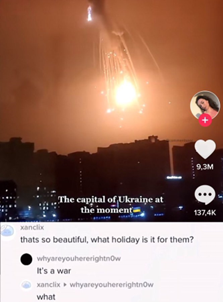
But what happened?[8]
At the border:
“Canadian passport. Any other foreign citizenships?”
“No”
“Go ahead.”
But the tension was palpable throughout my time there, especially if I was speaking English. Although typically a fan of eccentric dress, I kept to basic t-shirts and shorts. I shaved my legs. I cut my hair in a more conservative style and kept it in a headscarf with the 1980’s Moscow Olympic insignia. Overkill? Maybe… [TEXT EDITED]
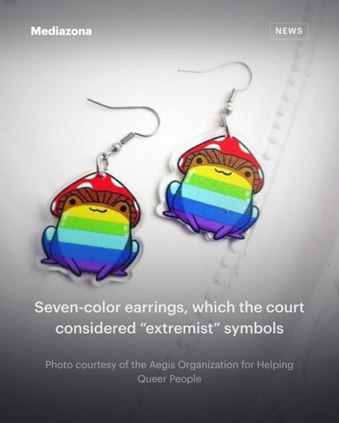
The pride flag doesn’t feature light blue… but let’s leave it to Russian authorities to determine what is God’s rainbow and what is terrorism.[12]
My body truly is illegal in the country of my birth. These laws are made on the grounds of revitalizing fabulated “traditional values.” Sound familiar? The same refrain is used the world over to push populist agendas. Traditionally, Russia was a somewhat permissive society. Anti-same-sex laws only began in Russia during the westernizing rule of Peter the Great. Previously, although sodomy was punishable by the church, the offence was on par with heterosexual sins such as extramarital sex or adultery.[13] Foreign travellers to the country note the debaucherousness of muscovite mores and the inconsequentiality of sodomy. [14] Alongside other biopolitical manouvres (i.e. discussion of anti-abortion legislation,) this is a bid to position Russia as a conservative leader alongside the American Christian Right in the culture wars.[15] But how can a country purporting to be “Anti-Western” be inviting and hosting American speakers and promulgating “Traditional American Family Values.” How can they hate America but love Trump, the all-American leader who will make America great again? I don’t know and I’m not going to get into that right now, though Naomi Klein’s latest book, Doppleganger, might provide some insight into the diagonalism of current politics. All I can say is:
WHAT A MESS!
My grandmother in that nursing home-- A senile senior shut away, out of sight. Tami Spry, in her article “Performing Autoethnography,” likens her to the researching Body – “The Body has become the hysterical and embarrassing relative, a “shut in” in the academy’s ivory tower.”[16] This comparison struck me as particularly apt given my physiological situation during the school year; I was struggling deeply with mental health challenges,[17] an undiagnosed eating disorder[18], hormonal imbalances caused by contraceptives,[19] and chronic upper respiratory infections requiring multiple courses of antibiotics.[20] Moreover, I was reckoning with the logics of my artistic process, conditioned by my neurodiversity (diagnosed ADHD and self-identifying with autism spectrum, postviral,[21] and post-antibiotic[22] neurocognitive experiences), as well as an addiction to social media that prevented attention from landing and staying in one place. I discovered that I am terrified of the uncertainty of the creative process. I have little faith that anything interesting or good or worthwhile will come from my mucking about without purpose. I was in a ceramics program, but COULD NOT for the life of me get my ass down into the ceramic studio for fear of “wasting my time” and getting messy in a literal and metaphorical sense. I wanted to escape my physicality; I desired nothing more than for my cognition to be free of the burden of the body, so I could scale that ivory tower and leap off, soaring into the limitless sky of intellectualization. Murmuring and murmurating with the New Materialists – Mother Donna, Jane Bennet, Thomas Nail as scraps of paper on a breeze. I wanted to be data analyzing itself. Pure energy. Leave that leaking meatbag behind and let me do my thaaaaaaaaang.
We treat the body, and we treat our elders, as inconveniences -- impediments to progress and profit. Apalech clan member and academic Tyson Yunkaporta questions why “scientists currently have to remove all traces of themselves” from their research to avoid “contamination” with the “filthy reality of belongingness.”[23] He asserts that our emu-like, narcissistic tendencies prevent us from living relationally because “if we can’t stand outside of a field we can’t own it.”[24] In her book “No Logo,” Canadian social activist Naiomi Klein asserts that “After establishing the “soul” of their corporations, the superbrand companies have gone on to rid themselves of their cumbersome bodies, and there is nothing that seems more cumbersome, more loathsomely corporeal, than the factories that produce their products” and the people therein.[25] I identify strongly with this loathesome corporeality… “NEEDS, NEEDS, NEEDS” screams Nora Turato in her live performance of pool7 and I feel her frustration: the sheer exhaustion of having to constantly satisfy basic needs – eating, shitting – and complex needs – not “eating shit,” not living a morally and ethically misaligned life (“how idealistic can we afford to be?”).[26] The corporations would agree – how frustrating it is when workers get tired, hungry, pregnant, sick… When they need to get paid and they need time off. When they are unpredictable. When they have ambitions, goals, or wish for change. Would that they stop that nonsense and produce as much as possible, as fast as possible, for as little money and fuss as possible. In Klein’s harrowing account of Export-Processing Zones in the global south, we witness the fruition of this hypercapitalist nightmare.[27] On an individual level, the promotion of the grindset culture, hustlebros, and body optimization are the equivalents.[28] Individualism is the name of the game – all of your problems can be solved if you Just. Get. Better. – no relationality required.
How does one become a disciplined and productive artist within the system and try to change it at the same time? How does one get messy with the material of one’s practice, and with the wider relational tangle of life? I tried the optimization approach: Daily gym sessions, journalling, therapy once a week, spending time with friends, antidepressants, more therapy, control, control, control. I’ll say this: it’s not a bad thing to have one’s life in some sort of order – I would be much worse off without my habits, and they genuinely give me a sense of stability in deeply uncertain times; however, my artistic process remained blocked until Suzan Ucmaklioglu, an Inclusive Design Specialist at Foster + Partners, came to speak at the RCA. I will paraphrase Suzan’s answer to a classmate who asked if designing for accessibility was more expensive: “If you build accessibility (nice chairs, lifts, ramps, handrails, etc.) into the budget, then it is not more expensive. Accessibility should not be seen as a luxury.” [29]
This notion struck me. I have for some time been inspired by the work of Yumi Sakugawa, who advocates a ritualistic approach - the creation of containers of time and space -- for disciplined creative work.[30] As the architect of my container, why had I not been considering my own accessibility needs? Why had I not been budgeting for the “induction processes” that I need to get me settled - multiple pee breaks, making a cup of tea, forgetting things and needing to go get them – as well as budgeting my energy for the clean-up and the long bike ride home from Battersea? Much like the best architects throughout the ages, I had failed to listen to the needs of those whom I am meant to serve (hint: it’s not my ego!) I had been ignoring the inefficient, illogical, “expensive” processes of my body in favour of an approach that presumes neurotypicality and productivity-focus.
People with energy-limiting disabilities are very familiar with this feeling, and often refer to energy budgeting as “Spoon Theory”[31] – one only has so many spoons per day, and each task, from toileting to socializing to working to playing, takes a spoon; once they’re gone –you’re done. I find myself rationing my energy and fearing the exhaustion of spoonlessness. A mental health crisis might leave me without spoons to spare (when I was expecting a full day of work to be done), or a good time might have to be cut short because I know I need to get home before I crash. My world has narrowed significantly, and I must be extra judicious with my energy spending to serve my creative purpose.
However, this recognition represents a shift in my perspective. Contraceptive hormones and antidepressant medications illuminated the reality that we are walking, talking bags of electrochemical impulses; I now see that the mind is a tempestuous child – the sea spray on a wave on an ocean. So foolish, to believe one has control... So foolish to ignore the infinitude of that from which it arises, and into which it will inevitably fall. A change in the neurochemical system creates massive effects that are beyond my cognitive ability to grasp or direct. There is little to be said for mind over matter when mind IS matter. Everything is matter—it is the unifying principle of life – and there is nothing beyond the material, no mind beyond the body.
For some time, I have known that communicating the interconnected nature of reality is my life’s purpose. On my 20th Birthday, I attended my first meditation at Mountain Rain Zen Centre in Vancouver, BC. I had been interested in Buddhism for some time, having dabbled in other religions and finding no connection – even to my ancestral spiritual practices of Orthodox Christianity and (potentially) Judaism.[32] That evening I meditated for the first time. Sometime during the 6 years of being in that formal Sangha community, I began to understand the task of my life: to communicate the insight of “Interbeing,”[33] derived from the fundamental Buddhist concepts of dependent origination[34] and emptiness:[35] [36] All phenomena are enmeshed in a net of interconnected influences, arise from undifferentiation and do not exist independently: “When there is this, that comes to be; with the arising of this, that arises. When there is not this, that does not come to be; with the cessation of this, that ceases.”[37] Therefore, phenomena are void of any intrinsic nature[38] or external animating principle. Thic Nhat Hahn skilfully formulates these teachings into the following maxim: “We do not exist independently… Everything relies on everything else in the cosmos in order to manifest.”[39] Visually, this is represented by the ancient vedic image of Indra’s net – a vast textile, wherein, at each knot, an infinitely faceted jewel reflects the cosmos and all other jewels, while retaining its independent identity as a single jewel.[40]
However, The Heart Sutra, a seminal text in the Soto Zen canon, teaches that arising and cessation themselves are also void of inherent self-nature[41] -- these concepts are merely expedient means towards an intuitive, embodied understanding of non-self. East Asian spiritualities often emphasize practice (meditation, chanting, and the ritualized copying and recitation of sutras) as meritorious and purifying activities that are imperative alongside dharma study.[42] This, I believe, is a more embodied approach to realizing prajna paramita, the perfection of wisdom of emptiness. My own mantra practice arose from various experiences at raves: on the dance floor, I began repeating words to myself such as “I am safe, I am loved, I am whole” and found that this repetition activated a somatic response- that is, just by saying these words, I felt a greater sense of safety, connection and grounding within a totally fluid situation. I understood, then, that words indeed have the power to alter our electrochemical makeup. Ritualized mantra and writing practice, along with asemic calligraphy as practiced by “Crazy” Zhang Xu[43] and Zhang Qiang,[44] inspired me to engage with writing-as-material. I began to use words as seeds, repeating phrases as I moved to “sketch” performances and generate new patterns from singular phrases. This intermingling of speech fragments and movements birthed the script and choreography of the Fragment/Movement performance.
The notion of “The Fragment” (i.e. the jewel retaining its jewel-ness) and its position within and connection to “The Whole” (i.e. the jewels infinitely mutually interreflecting and inextricably linked within the net) are fundamental to my work as I explore fragmentation through the medium of clay. Edmund de Waal, writing on the work of Cy Twombly, puts it most succinctly: “Fragments end abruptly. Their edges are their significance. They speak of wholeness and disjuncture at the same moment, hold their histories as a pause. They stretch into space… The break is the moment where storytelling begins.” The ecofeminist, post humanist mother of my mind Donna Haraway remarks that “Each time a story helps me remember what I thought I knew, or introduces me to new knowledge, a muscle critical for caring about flourishing gets some aerobic exercise. Such exercise enhances collective thinking and movement too. Each time I trace a tangle and add a few threads that first seemed whimsical but turned out to be essential to the fabric, I get a bit straighter that staying with the trouble of complex worlding is the name of the game of living and dying well together on terra.”[45] The edge, the boundary of the fragment is therefore the place where caring seeps through. When we understand that we are fragments always of a whole, the places of intersection become sites of collectivity. Tyson Yunkaporta asserts: “every time you meet someone and establish your relationship to that person, you are bringing together multiple universes. There is no way to be an outside observer of this system—you have to place yourself in it to see in three dimensions.”[46] Relationality, is therefore the key to seeing the world in its plurality and flourishing within its multidimensional splendour.

A layered spiderweb gives us a visual representation of Indra’s Net.[47]
Complexity theory reiterates the aforementioned Buddhist truths, as well as long-held indigenous knowledge, in terms more palatable to our conditioned (euro-western) ontology through the notions of assembly and emergence. Phenomena self-organize loosely into assemblages within systems. The assemblages are permeable, conditioned by their environments and their history, and their behaviours emerge as “unpredictable patterns of order.”[48] Complexity theory also introduces the concepts of criticality, the notion that systems are drawn towards edge states – an equipoise between order and chaos that can be easily tipped into change by relevant contingent factors.[49] In a healthy organism, this allows for flexibility and rapid adaptive responses to circumstance.[50] Therefore, in the words of Jane Bennet, a complex system is “a movement always on the way to becoming otherwise.”[51] Thomas Nail re-argues what indigenous people have always known: that everything is material in motion.[52] Wemindji Cree hunters understand that the world is in a constant process of being born[53] and Australian aborigines know that “creation is still unfolding now and will continue to unfold if we know how to know it.” [54]
Saulteaux-Cree Metis researcher Erynne Gilpin asserts that this recognition and acknowledgement of interbeing and interbecoming is the first step towards actualizing individual, collective healing. “In must begin in our own personal commitment to transcend fear, violence and systems of oppression. It must begin in the mental, physical and emotional bodies which house our own sacred Spirit, specific gifts and responsibilities to the Collective. It must begin with conscious clarity, compassion and a resounding Love for the Land and Waters: transcending into a love for Our Land (Body) and Waters (Spirit).”[55] Indigenous cosmologies acknowledge that the Land is the Body and the Body is the Land and that we start exactly from where we are
WE START FROM HERE.
WE START FROM HERE.
WE START FROM HERE.
THE DANCE CAN ONLY START FROM HERE.
Complexity theory reminds us of another vital property of nature: “The patterns of the universe repeat at scale.”[56] Therefore, our individual actions, though they may seem futile, echo outward. One of the greatest thinkers of our time, adrienne maree brown, advocates for small-scale, bottom up change through her Emergent Strategy approach. She reminds us of Grace Lee Boggs’ quote: “Transform yourself to transform the world.” This focus on individual and small-scale change differs from the hyper-optimized individualism described above because it must be relational. We can never transform ourselves without transforming everything around us – those of us seeking an individual path to security inadvertently reinforce the system we exist in because our intentions are focussed solely on ourselves and those like ourselves. We live in the house of modernity, and, though we see the walls crumbling, persist in our belief that our position at the top will shield us from instability, injustice, and illness.[57] But this comes at the cost, always, of those at the bottom and outside of the house. Who mines the lithium for the batteries that will drive our EV’s into the so-called “sustainable future?” Who disposes of those batteries? Who feels the effects of the acid leaking into the groundwater? Frederick Douglass reminds us that “No man can put a chain about the ankle of his fellow man without at last finding the other end fastened about his own neck” and, in our foolish lack of care, we ultimately harm ourselves.[58]
The fractal connections between enlightenment mind-body duality, intentional and ongoing exploitation of the global majority, and internalized subjugation of the body, have been clear to black, brown, indigenous feminists for some time. “This process of recognizing as social and systemic what was formerly perceived as isolated and individual”[59] is a decolonial practice and it is still radical to say “the personal is political.” Leanne Betasamosake Simpson, a Michi Saagiig Nishnaabeg scholar, writes about the severance that settler colonialism enacts upon people -- separating them from each other and from themselves – and upon land. For example, the Cartesian privileging of reason over emotion and thought over experiences has been used justify the dehumanization of Indigenous peoples as “closer to nature” or overly embodied and to disorient indigenous senses of self as relational.[60] Nishnaabeg epistemology, like other indigenous ways of knowing, is place-based; body, land, material – these are the sites of knowledge. In harming the land, in ignoring the body, in subjugating material to our whims rather than collaborating with its agentic nature, we commit epistemicide -- the destruction of knowledge contained therein; the world flattens, becomes more singular and unidimensional. Plurality is erased in favour of a grand narrative. “Recent traditions have emerged that break down creation systems like a virus, infecting complex patterns with artificial simplicity…” [61]
In light of the overwhelming damage that has already been done and will continue as the 1% of humanity scramble to hoard the few remaining resources, my question is: Where do we even begin? Our homework is to identify the coordinates of our location and reflect on the knowledge situated therein. What of my embodied knowledge is beneficial and what is harmful to myself and to the collective? Where is ignorance sanctioned? How has this knowledge been naturalized through geopolitical and institutional power relations/practices.[62] The problem is that this work is unmonetizable, and therefore invalid in the current human system of merit and value. It feeds me spiritually, but not materially. I fear that the work I do will not be understood, will not be valued; I fear falling through the cracks like so many of my loved ones, due to a lack of external validation.
A rite of passage recounted by Vanessa Machado Da Olivera in her fantastic book “hospicing modernity” helped me understand how to ground myself in intrinsic value:
“As I remember, in this ritual a young person would be buried naked in the earth vertically, with only their head sticking out. They would be there for four days, without food or water. Since they could not move, they had to do their necessities in that same place. They would have a helper keeping a fire nearby and watching for dangerous animals.
On the first day of the ritual, members of the community were supposed to collectively bury the person singing this person’s praises. On the second and third days of the ritual, members of the community were supposed to come to the head in the ground and spit and shout insults at it. The buried young person was not supposed to respond. They had to accept everything in silence—but not as a form of submission, quite the opposite. The young person was supposed to find their grounding on the living land that held them for the four days. In this way, their sense of intrinsic worth would not be grounded in human interactions—including the opinions of other members of their own community—but in the sense that we are held by the land itself. At the end of the fourth day, the young person was physically cleaned by members of the community, there was a feast, and dream-stories were shared.”[63]
Vanessa understood, through this story and through a personal experience in a car accident, that “being grounded in the physical and meta-physical “land,” in the inarticulable sense-fullness of non-separability that is the glue connecting everything” is the key to letting go of ego and human narratives of worth.[64]
In doing this work, I wade through the mud of my own hesitancy to act. Over and over again I reconfirm that relational connection to body, land, and others is vital… and yet here I am, sitting alone, writing an essay. Every time I confront the discomfort of embodiment, the discomfort of the unknown, my attention scurries back into overintellectualization. The thing is… I had a farm once. Well, I call it a farm when it was something like a ten by six metre plot of land on the grounds of the Kwantlen Polytechnic University Richmond Farm School (from which I graduated the year prior with a certificate in regenerative agriculture.) I attempted to grow snapdragons and dahlias, but my seedlings failed and my tubers didn’t sprout all that much. I tried my best to stay on top and keep the weeds from taking over, but had neither the planning skills, nor the mental and physical capacity to do such a thing on my own. Growing food is not my passion nor my path, and perhaps I felt rejected by the land…
Moreover, the land which holds my ancestral knowledge is no longer accessible to me (again, what happened?). How do we return to place-based knowledge when we cannot return to the place where the knowledge is based? Moreover, how can I draw on ancestral knowledge when my ancestors likely would have accepted that my queerness as punishable? Tasmanian indigenous thinker Lauren “Blackie” cautions of decolonizing efforts that are “’focused too much on ways of knowing rather than ways of being, causing a lot of Indigenous knowledge to be lost in theory rather than being embedded in daily life.”[65] What is the use of all these words, all these powerful quotes from Indigenous, Buddhist, New Materialist, Ecofeminist though leaders if I continue about my day-to-day without engaging in deep relationship with people, land and spirit? If I can barely bring myself to meditate on a regular basis? Recognizing my own penchant for overintellectualization, my answer to this has been to use the body and the material as synecdoche. Body is land, and there is much knowledge embedded theirin. If we would just listen to our body as if we were listening to a respected elder or ancestor, we would start to come in to an embodied understanding of interbeing. Likewise, the clay is part of the geological system of our earth and reflects a small part of the pattern: look how it cracks and breaks like tectonic plates or ice cream; look how it resembles skin and dunes. The electromagnetic forces that affect the platelet-shaped particles of clay are the same that influence DNA and protein-folding and allow geckos to climb up walls.[66] [67]
The Heart Sutra proclaims that Avalokiteshvara, the (canonically transgender!) bodhisattva of compassion, when practicing deeply with the perfection of wisdom, prajna paramita, understood the inherent undifferentiated nature of all being, and thus relieved their ill-being.[68] I take deep inspiration and comfort in this: we too can relieve our own ill-being, dukkha, and thus the dukkha of all beings, by coming to a more embodied understanding of non-separation. Once we realize that, when we lie down, with our full bodies on the pavement, we won’t fall through the cracks, that is when fear can be extinguished and the work of locating and relating can restart. We can begin again to move as fragments of a whole, embrace that we are one of a marvellous myriad of pluralities that arise from an undifferentiated mass, and begin to transform our messy reality into something more liveable.
[1] Though now I understand how little of what is donated is actually resold in the same country and not shipped off the the global south. ‘How Fast Fashion Is Using the Global South as a Dumping Ground for Textile Waste’, Greenpeace International (blog), 17 April 2025, https://www.greenpeace.org/international/story/53333/how-fast-fashion-is-using-global-south-as-dumping-ground-for-textile-waste/.
[2] ‘History as Written by Vladimir Putin’, POLITICO, 25 August 2023, https://www.politico.eu/article/vladimir-putin-russia-history-textbook-ukraine-war/.
[3] ‘Russian Schools in a Time of War: A Lesson in Indoctrination | Wilson Center’, 25 September 2023, https://web.archive.org/web/20230925020200/https://ukraine.wilsoncenter.org/blog-post/russian-schools-time-war-lesson-indoctrination.
[4] Эдуард Хиль - Как я Рад, Ведь я... Edward Hill ED (Вокализ) Trololo, 2011, https://www.youtube.com/watch?v=DnvPFK393ZU.
[5] ‘Ksenia Karelina: US-Russian Woman Jailed for 12 Years for $51 Charity Gift - BBC News’, accessed 7 June 2025, https://www.bbc.co.uk/news/articles/cp9rygl5k4jo.
[6] Though spyware firm Cellbrite’s controversial UFED technology has been allegedly discontinued in Russia since 2021, the company continues to collaborate with repressive governments and perpetuate human rights violations. Russian authorities have bragged about using Cellebrite’s technology more than 26,000 times. Natalia Krapiva and Sugiyama, ‘What Spy Firm Cellebrite Can’t Hide from Investors’, Access Now (blog), 26 May 2021, https://www.accessnow.org/what-spy-firm-cellebrite-cant-hide-from-investors/.
[7] Lily Hay Newman, ‘How to Protect Yourself From Phone Searches at the US Border’, Wired, accessed 7 June 2025, https://www.wired.com/story/how-to-protect-yourself-from-phone-searches-at-the-us-border/.
[8] ‘А Что Случилось? (@a4toslu4ilos) / X’, X (formerly Twitter), 5 April 2022, https://x.com/a4toslu4ilos.
[9] ‘The Facts on LGBT Rights in Russia - Council for Global Equality’, accessed 8 June 2025, https://www.globalequality.org/component/content/article/1-in-the-news/186-the-facts-on-lgbt-rights-in-russia.
[10] ‘Russia: First Convictions Under LGBT “Extremist” Ruling | Human Rights Watch’, 15 February 2024, https://www.hrw.org/news/2024/02/15/russia-first-convictions-under-lgbt-extremist-ruling.
[11] Mediazona [@mediazona_en], ‘“Extremist” Rainbow Frog. Young Woman Arrested over Earrings in Nizhny Novgorod Https://T.Co/fYv2bgNrQw’, Tweet, Twitter, accessed 8 June 2025, https://x.com/mediazona_en/status/1753414925513363880/photo/1.
[12] Mediazona [@mediazona_en].
[13] Как Геи Жили На Руси | Настоящие Традиционные Ценности России, 2024, https://www.youtube.com/watch?v=6iPiNUAmNwU.
[14] ‘A Sexuality like Any Other: How Gay-Tolerant Medieval Rus Borrowed Homophobia from the West and Stuck with It for Good’, The Insider, accessed 8 June 2025, https://theins.ru/en/society/259640.
[15] Kristina Stoeckl and Dmitry Uzlaner, ‘CHAPTER 5 Ambitions: The Russian Orthodox Church and Its Transnational Conservative Alliances’, in The Moralist International: Russia in the Global Culture Wars, ed. Aristotle Papanikolaou and Ashley M. Purpura (Fordham University Press, 2022), 85–102, https://www.degruyterbrill.com/document/doi/10.1515/9781531502126-007/html.
[16] Tami Spry, ‘Performing Autoethnography: An Embodied Methodological Praxis’, Qualitative Inquiry 7, no. 6 (December 2001): 706–32, https://doi.org/10.1177/107780040100700605.
[17] My depression got so bad that I had to get back on medication – something I was reluctant to trying again after a spectacularly unpleasant first attempt wherein I would rather have committed suicide than be on sertraline.
[18] Likely to do with the severe bloating I frequently experience due to IBS.
[19] Dating a cisgender man for the first time, I decided to get an IUD. The first one fell out after three days. The second one – a hormonal IUD—caused startling manifestations of my depressive symptoms, along with hot flashes and month-long menstruation. I had it removed and a copper one reinserted, but my bleeding periods are still up to 14 days long and very heavy.
[20] Themselves likely caused by post-COVID immune suppression, increased disease severity and antibiotic-resistance in a densely populated urban area, and a cheeky penchant for powdering my nose…
[21] Increasing evidence points to prolonged psychiatric and neurological consequences of COVID-19. Na Zeng et al., ‘A Systematic Review and Meta-Analysis of Long Term Physical and Mental Sequelae of COVID-19 Pandemic: Call for Research Priority and Action’, Molecular Psychiatry 28, no. 1 (January 2023): 423–33, https://doi.org/10.1038/s41380-022-01614-7.
[22] Repeated antibiotic use can cause gut dysbiosis, hindering the communication between gut microbiota and neurons and causing neuropsychiatric complications. Timothy G. Dinan and John F. Cryan, ‘The Microbiome-Gut-Brain Axis in Health and Disease’, Gastroenterology Clinics of North America, The Gut Microbiome, 46, no. 1 (1 March 2017): 77–89, https://doi.org/10.1016/j.gtc.2016.09.007.
[23] Tyson Yunkaporta, Sand Talk: How Indigenous Thinking Can Save the World, 1st ed (Melbourne: HarperCollins Publishers, 2020), 42.
[24] Yunkaporta, 42.
[25] Naomi Klein, ‘Chapter Nine: The Discarded Factory -- Degraded Production in the Age of the Superbrand’, in No Logo: No Space, No Choice, No Jobs, 10th anniversary ed (London: Fourth Estate, 2010).
[26] Nora Turato, Pool7, 6 June 2025, Live Performance, 6 June 2025, Institute of Contemporary Art.
[27] Naomi Klein, No Logo: No Space, No Choice, No Jobs, 10th anniversary ed (London: Fourth Estate, 2010).
[28] Maya Vinokour, ‘Beware Lifestyle Fascism’, Jacobin, 1 October 2024, https://jacobin.com/2024/01/lifestyle-fascism-wellness-biohacking-technofuturism-right-wing-ideology.
[29] Suzan Ucmaklioglu, ‘Inclusive Design’ (Talk, Royal College of Art, London, 27 January 2025).
[30] ‘DISCIPLINE IS PLEASURE: HOW TO CREATE STRUCTURE, HABITS, AND RITUALS TO BUILD YOUR CREATIVE PRACTICE’, crowdcast, accessed 8 June 2025, https://crowdcast.io/c/discplinepleasure.
[31] Christine’s blog seems to be defunct, but a pdf of the post is available. Christine Miserandino, ‘The Spoon Theory’, But You Don’t Look Sick (blog), 2003, https://lymphoma-action.org.uk/sites/default/files/media/documents/2020-05/Spoon%20theory%20by%20Christine%20Miserandino.pdf.
[32] My maternal grandmother was an orphan whose parents disappeared in the time of Jewish Persecution in the USSR. Halakha dictates that a child is considered Jewish if their mother is Jewish.
[33] Thich Nhat Hanh, ‘The Insight of Interbeing’, Garrison Institute, 2 August 2017, https://www.garrisoninstitute.org/insight-of-interbeing/.
[34] Robert E. Buswell and Donald Sewell Lopez, The Princeton Dictionary of Buddhism (Princeton (N.J.): Princeton University Press, 2014). 669
[35] Buswell and Lopez. 832
[36] ‘Sunyata | Emptiness, Voidness, Nothingness | Britannica’, 9 May 2025, https://www.britannica.com/topic/sunyata.
[37] Bhikku Ñāṇamoli and Bhikkhu Bodhi, The Middle Length Discourses of the Buddha: A [New] Translation of the Majjhima Nikāya ; Translated from the Pali, 4. ed, The Teachings of the Buddha (Boston: Wisdom Publ, 2009). 655
[38] Buswell and Lopez, The Princeton Dictionary of Buddhism. 832
[39] Hanh, ‘The Insight of Interbeing’.
[40] Buswell and Lopez, The Princeton Dictionary of Buddhism. 372
[41] ‘New Heart Sutra Translation by Thich Nhat Hanh’, Plum Village, 13 September 2014, https://plumvillage.org/about/thich-nhat-hanh/letters/thich-nhat-hanh-new-heart-sutra-translation.
[42] Bryan D. Lowe, Ritualized Writing: Buddhist Practice and Scriptural Cultures in Ancient Japan (University of Hawaii Press, 2017), https://doi.org/10.1515/9780824859435.
[43] Tim Gaze and Michael Jacobson, eds., ‘Preface’, in An Anthology of Asemic Handwriting (Punctum Books, 2013), 5–10, https://doi.org/10.2307/jj.2353916.2.
[44] Zhang Qiang and Han Jiarui, ‘International Experimental Calligraphy.’, Journal of Visual Art Practice 22, no. 4 (1 December 2023): 393–400, https://doi.org/10.1080/14702029.2023.2273071.
[45] Donna Jeanne Haraway, Staying with the Trouble: Making Kin in the Chthulucene, Experimental Futures: Technological Lives, Scientific Arts, Anthropological Voices (Durham: Duke University Press, 2016). 115-116
[46] Yunkaporta, Sand Talk, 40.
[47] ‘Water-Drops-on-Spiderweb-375787-Pixahive.Jpg (2560×1920)’, accessed 16 June 2025, https://pixahive.com/wp-content/uploads/2021/03/Water-drops-on-spiderweb-375787-pixahive.jpg.
[48] Dawn R. Gilpin and Priscilla J. Murphy, Crisis Management in a Complex World (New York: Oxford University Press, 2008).
[49] Per Bak, How Nature Works: The Science of Self-Organized Criticality (New York, NY: Springer New York, 1996).
[50] Guy C. Van Orden, Heidi Kloos, and Sebastian Wallot, ‘Living in the Pink: Intentionality, Wellbeing, and Complexity’, in Philosophy of Complex Systems, ed. Cliff Hooker, vol. 10, Handbook of the Philosophy of Science (Amsterdam: North-Holland, 2011), 629–72, https://doi.org/10.1016/B978-0-444-52076-0.50022-5.
[51] Jane Bennett, Vibrant Matter: A Political Ecology of Things (Durham: Duke University Press, 2010). 119
[52] Thomas Nail, Lucretius II: An Ethics of Motion (Edinburgh: Edinburgh university press, 2020).
[53] Tim Ingold, ‘Rethinking the Animate, Re-Animating Thought.’, Ethnos: Journal of Anthropology 71, no. 1 (1 March 2006): 9–20, https://doi.org/10.1080/00141840600603111.
[54] Yunkaporta, Sand Talk, 38.
[55] Erynne M. Gilpin, ‘Land as Body: Indigenous Womxn’s* Leadership, Land-Based Wellness and Embodied Governance’ (Doctor of Philosophy Ph.D., 27/01/2020, University of Victoria, 2020), https://dspace.library.uvic.ca/items/e66ca948-d385-4e7a-9eb3-ed3eac59b7cd/full. P. 134-135
[56] adrienne maree brown, Emergent Strategy: Shaping Change, Changing Worlds, Emergent Strategy Series, no. 0 (Chico, CA Edinburgh: AK Press, 2017).
[57] ‘House of Modernity (Zine)’, Gesturing Towards Decolonial Futures (blog), 7 October 2018, https://decolonialfutures.net/house-of-modernity-zine/.
[58] Frederick Douglass, ‘Civil Rights Mass Meeting Speech’ (Speech, Civil Rights Mass Meeting, Washington, DC, 22 October 1883), https://www.oxfordreference.com/display/10.1093/acref/9780191866692.001.0001/q-oro-ed6-00003786.
[59] Kimberle Crenshaw, ‘Mapping the Margins: Intersectionality, Identity Politics, and Violence against Women of Color’, Stanford Law Review 43, no. 6 (1991): 1241–99, https://doi.org/10.2307/1229039.
[60] Leanne Betasamosake Simpson, As We Have Always Done: Indigenous Freedom through Radical Resistance (University of Minnesota Press, 2017), https://doi.org/10.5749/j.ctt1pwt77c.
[61] Yunkaporta, Sand Talk, 3.
[62] ‘Decolonizing Posthumanist Geographies - Juanita Sundberg, 2014’, accessed 8 June 2025, https://journals.sagepub.com/doi/full/10.1177/1474474013486067?casa_token=aEzCXXfKHuIAAAAA%3A-kXp9wWi-xIxr35YZumDzn3Umjk5tA49s91arAEVMOz4Ux-iGH480y1DZKeKdGFXCdzD3rRNHt-ZRQ.
[63] Vanessa Machado de Oliveira, Hospicing Modernity: Facing Humanity’s Wrongs and the Implications for Social Activism (Berkely, California: North Atlantic Books, 2021).
[64] Machado de Oliveira.
[65] Yunkaporta, Sand Talk, 60.
[66] ‘IMFs in Your Everyday Lives’, Van der Waals Intermolecular forces, accessed 12 June 2025, http://vanderwaals.weebly.com/imfs-in-your-everyday-lives.html.
[67] R. G. Keil and L. M. Mayer, ‘12.12 - Mineral Matrices and Organic Matter’, in Treatise on Geochemistry (Second Edition), ed. Heinrich D. Holland and Karl K. Turekian (Oxford: Elsevier, 2014), 337–59, https://doi.org/10.1016/B978-0-08-095975-7.01024-X.
[68] ‘New Heart Sutra Translation by Thich Nhat Hanh’.
Bibliography
Bak, Per. How Nature Works: The Science of Self-Organized Criticality. New York, NY: Springer New York, 1996.
Bennett, Jane. Vibrant Matter: A Political Ecology of Things. Durham: Duke University Press, 2010.
Bhikku Ñāṇamoli and Bhikkhu Bodhi. The Middle Length Discourses of the Buddha: A [New] Translation of the Majjhima Nikāya ; Translated from the Pali. 4. ed. The Teachings of the Buddha. Boston: Wisdom Publ, 2009.
Brown, Adrienne Maree. Emergent Strategy: Shaping Change, Changing Worlds. Emergent Strategy Series, no. 0. Chico, CA Edinburgh: AK Press, 2017.
Buswell, Robert E., and Donald Sewell Lopez. The Princeton Dictionary of Buddhism. Princeton (N.J.): Princeton University Press, 2014.
Crenshaw, Kimberle. ‘Mapping the Margins: Intersectionality, Identity Politics, and Violence against Women of Color’. Stanford Law Review 43, no. 6 (1991): 1241–99. https://doi.org/10.2307/1229039.
crowdcast. ‘DISCIPLINE IS PLEASURE: HOW TO CREATE STRUCTURE, HABITS, AND RITUALS TO BUILD YOUR CREATIVE PRACTICE’. Accessed 8 June 2025. https://crowdcast.io/c/discplinepleasure.
‘Decolonizing Posthumanist Geographies - Juanita Sundberg, 2014’. Accessed 8 June 2025. https://journals.sagepub.com/doi/full/10.1177/1474474013486067?casa_token=aEzCXXfKHuIAAAAA%3A-kXp9wWi-xIxr35YZumDzn3Umjk5tA49s91arAEVMOz4Ux-iGH480y1DZKeKdGFXCdzD3rRNHt-ZRQ.
Dinan, Timothy G., and John F. Cryan. ‘The Microbiome-Gut-Brain Axis in Health and Disease’. Gastroenterology Clinics of North America, The Gut Microbiome, 46, no. 1 (1 March 2017): 77–89. https://doi.org/10.1016/j.gtc.2016.09.007.
Douglass, Frederick. ‘Civil Rights Mass Meeting Speech’. Speech presented at the Civil Rights Mass Meeting, Washington, DC, 22 October 1883. https://www.oxfordreference.com/display/10.1093/acref/9780191866692.001.0001/q-oro-ed6-00003786.
Gaze, Tim, and Michael Jacobson, eds. ‘Preface’. In An Anthology of Asemic Handwriting, 5–10. Punctum Books, 2013. https://doi.org/10.2307/jj.2353916.2.
Gesturing Towards Decolonial Futures. ‘House of Modernity (Zine)’, 7 October 2018. https://decolonialfutures.net/house-of-modernity-zine/.
Gilpin, Dawn R., and Priscilla J. Murphy. Crisis Management in a Complex World. New York: Oxford University Press, 2008.
Gilpin, Erynne M. ‘Land as Body: Indigenous Womxn’s* Leadership, Land-Based Wellness and Embodied Governance’. Doctor of Philosophy Ph.D., University of Victoria, 2020. https://dspace.library.uvic.ca/items/e66ca948-d385-4e7a-9eb3-ed3eac59b7cd/full.
Greenpeace International. ‘How Fast Fashion Is Using the Global South as a Dumping Ground for Textile Waste’, 17 April 2025. https://www.greenpeace.org/international/story/53333/how-fast-fashion-is-using-global-south-as-dumping-ground-for-textile-waste/.
Hanh, Thich Nhat. ‘The Insight of Interbeing’. Garrison Institute, 2 August 2017. https://www.garrisoninstitute.org/insight-of-interbeing/.
Haraway, Donna Jeanne. Staying with the Trouble: Making Kin in the Chthulucene. Experimental Futures: Technological Lives, Scientific Arts, Anthropological Voices. Durham: Duke University Press, 2016.
Ingold, Tim. ‘Rethinking the Animate, Re-Animating Thought.’ Ethnos: Journal of Anthropology 71, no. 1 (1 March 2006): 9–20. https://doi.org/10.1080/00141840600603111.
Keil, R. G., and L. M. Mayer. ‘12.12 - Mineral Matrices and Organic Matter’. In Treatise on Geochemistry (Second Edition), edited by Heinrich D. Holland and Karl K. Turekian, 337–59. Oxford: Elsevier, 2014. https://doi.org/10.1016/B978-0-08-095975-7.01024-X.
Klein, Naomi. ‘Chapter Nine: The Discarded Factory -- Degraded Production in the Age of the Superbrand’. In No Logo: No Space, No Choice, No Jobs, 10th anniversary ed. London: Fourth Estate, 2010.
——. No Logo: No Space, No Choice, No Jobs. 10th anniversary ed. London: Fourth Estate, 2010.
Krapiva, Natalia, and Hinako Sugiyama. ‘What Spy Firm Cellebrite Can’t Hide from Investors’. Access Now (blog), 26 May 2021. https://www.accessnow.org/what-spy-firm-cellebrite-cant-hide-from-investors/.
‘Ksenia Karelina: US-Russian Woman Jailed for 12 Years for $51 Charity Gift - BBC News’. Accessed 7 June 2025. https://www.bbc.co.uk/news/articles/cp9rygl5k4jo.
Lowe, Bryan D. Ritualized Writing: Buddhist Practice and Scriptural Cultures in Ancient Japan. University of Hawaii Press, 2017. https://doi.org/10.1515/9780824859435.
Machado de Oliveira, Vanessa. Hospicing Modernity: Facing Humanity’s Wrongs and the Implications for Social Activism. Berkely, California: North Atlantic Books, 2021.
Mediazona [@mediazona_en]. ‘“Extremist” Rainbow Frog. Young Woman Arrested over Earrings in Nizhny Novgorod Https://T.Co/fYv2bgNrQw’. Tweet. Twitter. Accessed 8 June 2025. https://x.com/mediazona_en/status/1753414925513363880/photo/1.
Miserandino, Christine. ‘The Spoon Theory’. But You Don’t Look Sick (blog), 2003. https://lymphoma-action.org.uk/sites/default/files/media/documents/2020-05/Spoon%20theory%20by%20Christine%20Miserandino.pdf.
Nail, Thomas. Lucretius II: An Ethics of Motion. Edinburgh: Edinburgh University Press, 2020.
Newman, Lily Hay. ‘How to Protect Yourself From Phone Searches at the US Border’. Wired. Accessed 7 June 2025. https://www.wired.com/story/how-to-protect-yourself-from-phone-searches-at-the-us-border/.
Plum Village. ‘New Heart Sutra Translation by Thich Nhat Hanh’, 13 September 2014. https://plumvillage.org/about/thich-nhat-hanh/letters/thich-nhat-hanh-new-heart-sutra-translation.
POLITICO. ‘History as Written by Vladimir Putin’, 25 August 2023. https://www.politico.eu/article/vladimir-putin-russia-history-textbook-ukraine-war/.
Qiang, Zhang, and Han Jiarui. ‘International Experimental Calligraphy.’ Journal of Visual Art Practice 22, no. 4 (1 December 2023): 393–400. https://doi.org/10.1080/14702029.2023.2273071.
‘Russia: First Convictions Under LGBT “Extremist” Ruling | Human Rights Watch’, 15 February 2024. https://www.hrw.org/news/2024/02/15/russia-first-convictions-under-lgbt-extremist-ruling.
‘Russian Schools in a Time of War: A Lesson in Indoctrination | Wilson Center’, 25 September 2023. https://web.archive.org/web/20230925020200/https://ukraine.wilsoncenter.org/blog-post/russian-schools-time-war-lesson-indoctrination.
Simpson, Leanne Betasamosake. As We Have Always Done: Indigenous Freedom through Radical Resistance. University of Minnesota Press, 2017. https://doi.org/10.5749/j.ctt1pwt77c.
Spry, Tami. ‘Performing Autoethnography: An Embodied Methodological Praxis’. Qualitative Inquiry 7, no. 6 (December 2001): 706–32. https://doi.org/10.1177/107780040100700605.
Stoeckl, Kristina, and Dmitry Uzlaner. ‘CHAPTER 5 Ambitions: The Russian Orthodox Church and Its Transnational Conservative Alliances’. In The Moralist International: Russia in the Global Culture Wars, edited by Aristotle Papanikolaou and Ashley M. Purpura, 85–102. Fordham University Press, 2022. https://www.degruyterbrill.com/document/doi/10.1515/9781531502126-007/html.
‘Sunyata | Emptiness, Voidness, Nothingness | Britannica’, 9 May 2025. https://www.britannica.com/topic/sunyata.
‘The Facts on LGBT Rights in Russia - Council for Global Equality’. Accessed 8 June 2025. https://www.globalequality.org/component/content/article/1-in-the-news/186-the-facts-on-lgbt-rights-in-russia.
The Insider. ‘A Sexuality like Any Other: How Gay-Tolerant Medieval Rus Borrowed Homophobia from the West and Stuck with It for Good’. Accessed 8 June 2025. https://theins.ru/en/society/259640.
Turato, Nora. Pool7. 6 June 2025. Live Performance. Institute of Contemporary Art.
Ucmaklioglu, Suzan. ‘Inclusive Design’. Talk, Royal College of Art, London, 27 January 2025.
Van der Waals Intermolecular forces. ‘IMFs in Your Everyday Lives’. Accessed 12 June 2025. http://vanderwaals.weebly.com/imfs-in-your-everyday-lives.html.
Van Orden, Guy C., Heidi Kloos, and Sebastian Wallot. ‘Living in the Pink: Intentionality, Wellbeing, and Complexity’. In Philosophy of Complex Systems, edited by Cliff Hooker, 10:629–72. Handbook of the Philosophy of Science. Amsterdam: North-Holland, 2011. https://doi.org/10.1016/B978-0-444-52076-0.50022-5.
Vinokour, Maya. ‘Beware Lifestyle Fascism’. Jacobin, 1 October 2024. https://jacobin.com/2024/01/lifestyle-fascism-wellness-biohacking-technofuturism-right-wing-ideology.
‘Water-Drops-on-Spiderweb-375787-Pixahive.Jpg (2560×1920)’. Accessed 16 June 2025. https://pixahive.com/wp-content/uploads/2021/03/Water-drops-on-spiderweb-375787-pixahive.jpg.
X (formerly Twitter). ‘А Что Случилось? (@a4toslu4ilos) / X’, 5 April 2022. https://x.com/a4toslu4ilos.
Yunkaporta, Tyson. Sand Talk: How Indigenous Thinking Can Save the World. 1st ed. Melbourne: HarperCollins Publishers, 2020.
Zeng, Na, Yi-Miao Zhao, Wei Yan, Chao Li, Qing-Dong Lu, Lin Liu, Shu-Yu Ni, et al. ‘A Systematic Review and Meta-Analysis of Long Term Physical and Mental Sequelae of COVID-19 Pandemic: Call for Research Priority and Action’. Molecular Psychiatry 28, no. 1 (January 2023): 423–33. https://doi.org/10.1038/s41380-022-01614-7.
Как Геи Жили На Руси | Настоящие Традиционные Ценности России, 2024. https://www.youtube.com/watch?v=6iPiNUAmNwU.
Эдуард Хиль - Как я Рад, Ведь я... Edward Hill ED (Вокализ) Trololo, 2011. https://www.youtube.com/watch?v=DnvPFK393ZU.